Saturday, June 9, 2012

Be A Man!

In the most recent general conference, Elder Jeffrey R. Holland made an appeal to the men to, 'step up' and 'be men'. The call to 'be a man', colloquially and sometimes humorously used to motivate a burst of courage, was anything but a joke to Elder Holland.

What does it mean to be a man? The conclusion we come to may depend on who we ask. The world around us sends an ever-changing message on what manhood is. Not many years ago that message was based on grit, toughness and persistence. Clint Eastwood, Rocky Balboa and the generals of World War II were held up as 'real men'.

Now that image of manhood is considered cliche and old fashioned. The world's next attempt to define manhood pointed to the extremely successful-- the Bill Gates' of society who have every want satisfied with money to spare. Just as non-butch young men struggled with the previous definition of manhood, many in the rising generation have become discouraged by worldly pressures to provide an unrealistic level of income for themselves or their families.

Yet modern man, in the world's view, has evolved beyond the role of provider to something much less responsible. Elder D. Todd Christofferson explained it this way:

Some act as if man's highest goal should be his own pleasure. Permissive social mores have 'let men off the hook' as it were, so that many think it acceptable to father children out of wedlock and cohabit rather than marry. Dodging commitments is considered smart, but sacrificing for the good of others, naive.


The elusive, constantly changing messages of what the world calls manhood miss the target entirely and seek only to toss men 'to and fro with every wind of doctrine', as it were. These definitions attempt to restrict men to the selfish impulses of their carnal natures-- the very natures which stand in opposition to God (see Mosiah 3:19, Jeremiah 17:5, D&C 3:7, Moses 1:10).

So we're left again to ask what it means to be a man. The gospel of Jesus Christ provides a firm foundation upon which men can build their identity as men.

The scriptures teach that men are made in the image of God-- literal sons of God, eternal in nature and the focal point of God's glory. Men are called to be stewards over the whole earth and trusted to care for our sisters, daughters of the Most High. Every man has within himself the potential to be like our Heavenly Father, heirs of all He has and able to overcome every obstacle that may fall into our path. Real men, the gospel teaches, are mature, cheerful people who respond to the call to preside and provide.

Modern prophets also show the way to be a man. Elder Christofferson said, 'It is a wonderful aspiration for a boy to become a man--strong and capable; someone who can build and create things, run things; someone who makes a difference in the world.' Citing the proclamation on the family, he continued, 'In large measure, true manhood is defined in our relationship to women'. Real men honor marital vows with complete fidelity, help rear their children, preside with in love and righteousness and take responsibility to provide the necessities of life and protection for their families.

Elder Christofferson had a few more things to say about manhood:

Integrity is fundamental to being men. Integrity means being truthful, but it also means accepting responsibility and honoring commitments and covenants... A man of integrity will honestly face and correct his mistakes... True manhood is not always measured by the fruits of one's labors but by the labors themselves-- by one's striving. Though he will make some sacrifices and deny himself some pleasures in the course of honoring his commitments, the true man leads a rewarding life. He gives much, but he receives more, and he lives content in the approval of his Heavenly Father. The life of true manhood is the good life.

President Kimball once quoted U.S. President J. Edgar Hoover's answer to what makes a real man:

There are many things, but perhaps the inner voice he listened to as a young boy was most important of all. That voice we call conscience, and it directs one’s thoughts. What one thinks may find expression in actions. Since repeated actions form habits, the thoughts you are thinking and the things you are doing at this moment tend to reveal the kind of a man you will be.

Were I asked what a boy needs to do today in order to be a man worthy of the name tomorrow, I would say: Never lie and never cheat. A liar is a weakling. A cheat is both a weakling and a thief. In finding the courage to honor truth in all things, you are on the way to self-mastery.

Work hard. Your mind is a storehouse and you stock the shelves. Stock them with quality goods. Remember that the habits of work and study you form today are the ones you will live with tomorrow.

Have fun. Play active games which require stamina and sportsmanship. Abide by the rules yourself. Demand that others do likewise.

Honor your Creator. God is the source of all good. The ideals on which the nation is founded stem from him who is the author of Liberty. You can express appreciation for your priceless heritage best by living according to the code of ‘Duty, Honor, Country, and God.’

If you do these, and in all things do your best, the mind and heart and soul you develop will one day be those of a real man.

These are the ideals of manhood: integrity, kindness, strength, honor and duty.
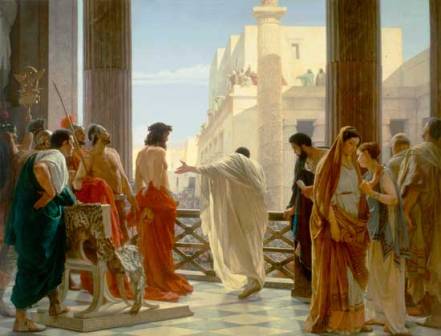
Manhood finds its ultimate expression in our ultimate example. Pilate may not have understood the significance of his words when he brought Jesus forth wearing a crown of thorns and declared, 'Behold the man!' As Elder Christofferson taught, Christ showed us the way to be men by rejecting temptation, by obedience, by forsaking completely the 'natural man', by service, by fearless opposition to evil and error and by standing firm in defending sacred things and raising a warning voice.

What manner of men ought we to be? Even as he is (3 Nephi 27:27, Matthew 5:48, 1 John 3:2).

As once Lehi called upon his sons to awake and rise from the dust and be men, so the prophets of today have called upon the men of our generation to 'step up'. President Monson has reminded us that we are not spectators. Elder Bednar counseled that when men 'neglect to do what is necessary to qualify for priesthood power' their efforts are 'unnaceptable to the Lord'. Elder Uchtdorf called upon men to put into practice dormant doctrines-- those that lie in our hears yet unapplied in our lives-- to qualify ourselves as husbands, fathers and sons.
Rise up, O men of God!
Have done with lesser things.
Give heart and soul and mind and strength
To serve the King of Kings.
Rise up, O men of God,
In one united throng.
Bring in the day of brotherhood
And end the night of wrong.
Rise up, O men of God!
Tread where his feet have trod.
As brothers of the Son of Man,
Rise up, O men of God!

Wednesday, May 30, 2012

God Will Lift Us Up


Hearken unto me, ye that know righteousness, the people in whose heart I have written my law, fear ye not the reproach of men, neither be ye afraid of their revilings.

For moth shall eat them up like a garment, and the worm shall eat them like wool. But my righteousness shall be forever, and my salvation from generation to generation.

I am he; yea, I am he that comforteth you. Behold, who art thou, that thou shouldst be afraid of man? And forgettest the Lord thy maker, that hath stretched forth the heavens, and laid the foundations of the earth?

Therefore, the redeemed of the Lord shall return, and come with signing into Zion; and everlasting joy and holiness shall be upon their heads; and they shall obtain gladness and joy; sorrow and mourning shall flee away.

2 Nephi 8:7-8, 12, 11; see also Isaiah 51

Friday, May 25, 2012

A Time to Prepare

In the October 2011 General Conference, Elder Ian S. Ardern delivered an address titled, 'A Time to Prepare'. It was an excellent talk worth reviewing again and again. In his remarks, Elder Ardern reminded us:

Time is never for sale; time is a commodity that cannot, try as you may, be bought at any store for any price. Yet when time is wisely used, its value is immeasurable. On any given day we are allocated, without cost, the same number of minutes and hours to use... What time we have we must use wisely.

Though it often seems like we own the time that is granted to us, the Lord has made it clear that he is very interested in how we use that time. He has instructed us to 'cease to be idle' and to be 'anxiously engaged in a good cause' (Alma 38:12, D&C 88:124, D&C 58:27). President Brigham Young taught that 'we are all indebted to God for the ability to use time to advantage, and he will require of us a strict accounts of [its] disposition' (Teachings of Presidents of the Church: Brigham Young [1997], 286). Indeed, the Lord has said that 'he who is faithful and wise in time is accounted worthy to inherit the mansions prepared for him of my Father' (D&C 72:4).

While our choices certainly determine how we use our time, clearly our relationship with time is one of stewardship. The gift of time we receive from our Heavenly Father is also a responsibility and an opportunity to prove our ability to manage ourselves well.

In the parable of the talents found in Matthew 25, Christ taught us something about how stewardship assignments work. The master of the house gave three of his servants some coins to invest while he was away. Two of the servants had doubled the investments assigned to their care to the pleasure of their master. 'Well done, good and faithful servant,' the master told them. 'Thou hast been faithful over a few things, I will make thee ruler over many things: enter thou into the joy of thy lord.'

The third servant hid the coin given to him in the dirt. The master of the house was angry with this servant's slothfulness and took away this servant's stewardship, casting him out of the house.

As the stewards of our time, the Lord has commanded us that we 'shalt not idle away [our] time, neither shalt thou bury thy talent' (D&C 60:13). We are idle when we are 'uninvolved in righteous works'. The For the Strength of Youth pamphlet explains a few of the reasons why: 'Idleness can lead to inappropriate behavior, damaged relationships, and sin.' It continues, 'One form of idleness is spending excessive amounts of time in activities that keep you from productive work, such as using the Internet, playing video games, and watching television.'

Elder Ardern had the same message last October. He said:

The poor use of time is a close cousin of idleness. As we follow the command to 'cease to be idle', we must be sure that being busy also equates to being productive... I sense that some are trapped in a new time-consuming addiction—one that enslaves us to be constantly checking and sending social messages and thus giving the false impression of being busy and productive... Electronic games and cyber acquaintances are no lasting substitute for real friends who can give an encouraging hug, who can pray for us and seek after our best interest.

Perhaps this kind of idleness--when hours are wasted while appearing or even believing we a busy--is more dangerous than the bored image of idleness as a void of activity. In a recent CES Fireside, Elder David A. Bednar shared a similar concern as Elder Ardern. He said:

Sadly, some young men and young women in the Church today ignore 'things as they really are' and neglect eternal relationships for digital distractions, diversions, and detours that have no lasting value. My heart aches when a young couple—sealed together in the house of the Lord for time and for all eternity by the power of the holy priesthood—experiences marital difficulties because of the addicting effect of excessive video gaming or online socializing. A young man or woman may waste countless hours, postpone or forfeit vocational or academic achievement, and ultimately sacrifice cherished human relationships because of mind- and spirit-numbing video and online games...

I raise an apostolic voice of warning about the potentially stifling, suffocating, suppressing, and constraining impact of some kinds of cyberspace interactions and experiences upon our souls. The concerns I raise are not new; they apply equally to other types of media, such as television, movies, and music. But in a cyber world, these challenges are more pervasive and intense. I plead with you to beware of the sense-dulling and spiritually destructive influence of cyberspace technologies that are used to produce high fidelity and that promote degrading and evil purposes.

If the adversary cannot entice us to misuse our physical bodies, then one of his most potent tactics is to beguile you and me as embodied spirits to disconnect gradually and physically from things as they really are. In essence, he encourages us to think and act as if we were in our premortal, unembodied state. And, if we let him, he can cunningly employ some aspects of modern technology to accomplish his purposes. Please be careful of becoming so immersed and engrossed in pixels, texting, earbuds, twittering, online social networking, and potentially addictive uses of media and the Internet that you fail to recognize the importance of your physical body and miss the richness of person-to-person communication. Beware of digital displays and data in many forms of computer-mediated interaction that can displace the full range of physical capacity and experience.


In the Book of Mormon, Alma taught Zeezrom that though we all die, this life is a 'probationary state; a time to prepare to meet God' (Alma 12:24). Brigham Young taught that when we do meet God, we will be expected to give an accounting of that time. And Christ taught that if we are accounted worthy, we may be admitted into the 'joy of the lord' where we will be made 'rulers over many things' because of our wise stewardship.

Our use of time matters. With so many warnings to use our time well, we should be careful to put first the things that matter most, particularly our families and our relationship with our Heavenly Father. I join my testimony to Elder Ardern's:

I know our greatest happiness comes as we tune in to the Lord (see Alma 37:37) and to those things which bring a lasting reward, rather than mindlessly tuning in to countless hours of status updates, Internet farming, and catapulting angry birds at concrete walls. I urge each of us to take those things which rob us of precious time and determine to be their master, rather than allowing them through their addictive nature to be the master of us.

To have the peace the Savior speaks of (see John 14:27), we must devote our time to the things that matter most, and the things of God matter most. As we engage with God in sincere prayer, read and study each day from the scriptures, ponder on what we have read and felt, and then apply and live the lessons learned, we draw nearer to Him... 

Time marches swiftly forward to the tick of the clock. Today would be a good day, while the clock of mortality ticks, to review what we are doing to prepare to meet God. I testify that there are great rewards for those who take time in mortality to prepare for immortality and eternal life.

Wednesday, May 23, 2012

Living To Be Happy

Three short chapters after Lehi declared that "men are that they might have joy", Nephi reports that his people, now distanced from his dangerous, short-tempered brothers, lived "after the manner of happiness" (2 Nephi 5:27).

At first glance, Nephi's life may not look particularly happy. His father and mother had passed away, he lived in the wilderness where hard work was required to survive from year to year and he made swords in his spare time to defend his family from his brothers who would attack from time to time.

Obviously, those aren't likely the details to which Nephi referred. Instead, consider this list of behaviors that he mentions in that same chapter. As you read, contemplate which of these you are doing, which you could do better and how your life could be happier. Nephi reports:

All those who would go with me were those who believed in the warnings and the revelations of God; wherefore, they did hearken unto my words (v. 6).

We did observe to keep the judgments, and the statutes, and the commandments of the Lord in all things (v. 10).

The Lord was with us; and we did prosper exceedingly; for we did sow seed, and we did reap again in abundance. And we began to raise flocks, and herds, and animals of every kind (v. 11).

I, Nephi, had also brought the records which were engraven upon the plates of brass; and also the ball, or compass, which was prepared for my father by the hand of the Lord (v. 12).

We began to prosper exceedingly, and to multiply in the land (v. 13).

I, Nephi, did take the sword of Laban, and after the manner of it did make many swords, lest by any means the people who were now called Lamanites should come upon us and destroy us (v. 14).

I, Nephi, did build a temple (v. 16).

I, Nephi, did cause my people to be industrious, and to labor with their hands (v. 17).

I, Nephi, was desirous that [my people] should have no king; nevertheless, I did for them according to that which was in my power (v. 18).

By doing these things, Nephi writes that his people found happiness. The same principles can be likened to us today. As we live the gospel, we can be happy despite whatever else may be going on in our lives.